 +91



The Backup Power Reality for Jaspur Commercial Centers
Commercial hubs across Jaspur — including busy market retail corridors near Kotwali, Subhash Chowk, and the wholesale timber and rice trading yards — experience scheduled and unscheduled power cuts during peak daytime hours. To ensure uninterrupted billing computers, commercial beverage refrigeration, and specialized machinery, nearly every business relies on high-capacity sine-wave inverters or diesel generators (DG sets).
However, many of these systems are wired by untrained local handymen who cut corners on circuit isolation and neutral earthing, creating severe electrical shock risks and dangerous equipment burnouts.
The 3 Most Critical Backup Wiring Hazards
1. Dangerous "Floating Neutral" and Shared Neutral Looping
The single most hazardous mistake committed in small shops is looping the inverter neutral wire directly into the building's utility grid neutral line. When the utility grid fails, the neutral conductor ceases to be grounded at the transformer. If a single appliance develops an insulation fault, the entire neutral line becomes energized at up to 230V, delivering severe shocks to anyone touching metal computer cabinets, metal display racks, or water dispensers.
2. Manual Knife-Blade Changeover Switches
Old-fashioned open knife changeover switches are prone to heavy electrical arcing during switching. Furthermore, if an operator throws the switch improperly, it can backfeed generator power into the main utility grid, posing a lethal electrocution threat to UPCL line maintenance workers servicing nearby street poles.
3. Undersized Battery Cables
A 24V or 48V commercial inverter running a 3.5 kVA load draws up to 140 Amperes of DC current from battery banks. This demands heavy-gauge, multi-strand 25 sq.mm or 35 sq.mm copper cables. Using cheap 10 sq.mm cables causes the wire to heat up to over 100°C, melting terminal lugs and risking catastrophic lead-acid battery explosions.
The REFIXEL Professional Standard for Commercial Power Backup
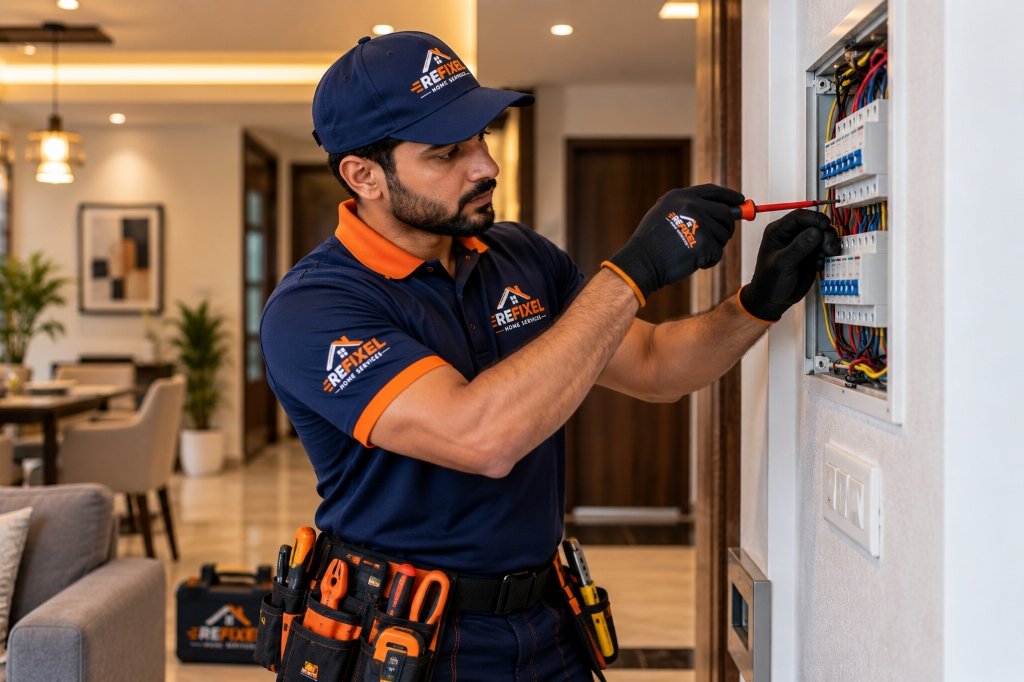
REFIXEL's licensed electrical technicians implement strict Indian Electricity (IE) Rule compliance for all commercial backup installations:
- Installation of Motorized 4-Pole Changeover Switches (ATS): Guarantees break-before-make operation, switching both phase and neutral lines simultaneously and eliminating any chance of grid feedback.
- Chemical Maintenance-Free Earth Pits: We construct dedicated copper-bonded earthing pits with moisture-retaining bentonite compound, maintaining resistance below 2 Ohms for prompt breaker tripping during faults.
- Adequate Battery Ventilation Planning: Ensuring battery enclosures have continuous natural or forced air ventilation to prevent combustible hydrogen gas pockets from accumulating.
Preventive Battery Terminal Care & Acid Top-Up Rules
In addition to electrical wiring, maintaining tubular lead-acid batteries is crucial for business continuity in Jaspur. High ambient temperatures accelerate electrolyte water evaporation. To prolong battery lifespan:
- Use Only Demineralized or Battery-Grade Distilled Water: Never top up batteries with tap water or RO drinking water, as trace minerals permanently poison lead plates and reduce battery backup capacity by 50%.
- Petroleum Jelly on Terminal Posts: Apply a thick coating of pure petroleum jelly on lead terminals to prevent green and white copper sulfate oxidation crusts that cause high resistance and voltage drops.
- Annual Specific Gravity Hydrometer Audit: REFIXEL electricians test battery electrolyte specific gravity with calibrated hydrometers to detect degraded dead cells before they damage the entire connected bank.