 +91



The Water Storage Challenge in Jaspur
Water supplies in Jaspur, especially in residential pockets surrounding Gandhi Chowk, Subhash Chowk, and Afzalgarh Road, rely heavily on deep borehole groundwater. While borehole water is naturally free from surface pathogens, it carries heavy concentrations of dissolved iron, manganese, and silt particles. When pumped into storage sumps, these minerals oxidize upon contact with air, settling as a dense reddish-brown sediment at the bottom of concrete sumps and rooftop tanks.
Over a span of 12 to 24 months, this sediment layer thickens into a foul sludge. Warm seasonal temperatures stimulate the growth of blue-green algae, coliform bacteria, and biofilms that cling tenaciously to tank walls and enter domestic plumbing taps.
The Client Case: Dr. S. K. Chauhan
Dr. S. K. Chauhan, a respected medical practitioner residing near Gandhi Chowk in Jaspur, contacted REFIXEL after noticing recurrent bouts of waterborne gastroenteritis among family members. Inspection of the property's 5,000-liter underground concrete sump revealed over 5 inches of accumulated red-brown mud, insect molts, and noticeable sulfur odors. The 2,000-liter rooftop Sintex tank was similarly lined with slippery green algal slime.
REFIXEL's 6-Stage Mechanized Tank Purification Protocol
Rather than adopting the dangerous manual method of sending an untrained worker with a dirty broom and bucket of caustic detergent into the tank, REFIXEL deployed our certified mechanized hygiene system:
Stage 1: Deep Dewatering via Submersible Slurry Pump
Using a specialized stainless steel submersible drainage pump, the standing water was evacuated down to the last 2 inches without stirring the bottom sediment into household delivery lines.
Stage 2: High-Suction Sludge Extraction
A high-power industrial sludge extractor pump was lowered into the sump. The heavy slurry, decaying organic silt, and sand were suctioned directly into external sealed disposal containers.
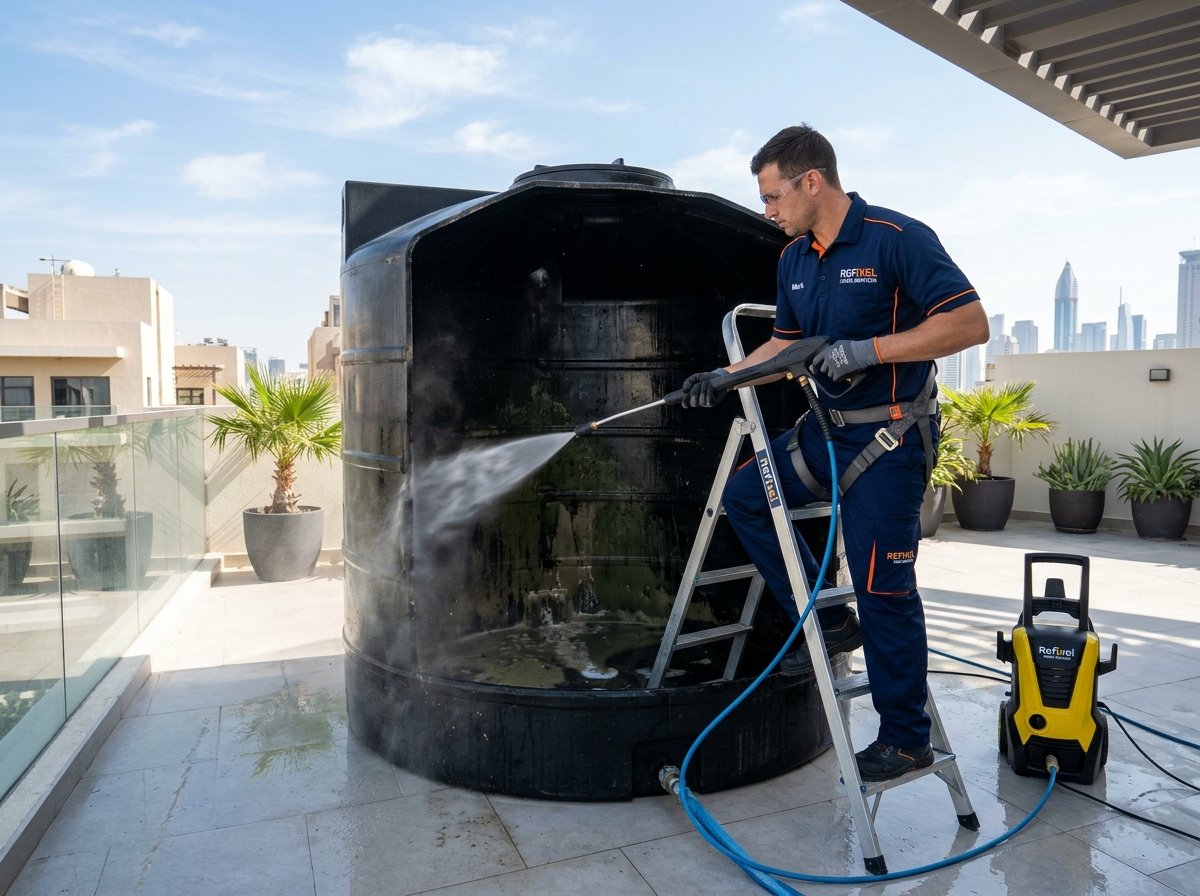
Stage 3: 150-Bar High-Pressure Rotary Jet Scrubbing
Our technician, equipped with clean safety gumboots and waterproof apparel, utilized a 150-bar rotary pressure jet lance. The concentrated high-velocity water fan stripped calcium incrustations, iron stains, and algae from concrete pores and tank ceiling slabs without abrasive damage to plaster.
Stage 4: Complete Vacuum Drying
A heavy-duty wet vacuum was deployed to eliminate all loosened slurry, leaving the floor and corners of the tank completely dry and free from standing puddle water.
Stage 5: Odorless Hydrogen Peroxide Disinfection
We misted all interior surfaces with a food-grade, hospital-approved hydrogen peroxide and silver ion disinfectant spray. Unlike bleaching powder, this formulation breaks down into harmless water and oxygen, leaving zero residual chemical taste or harmful trihalomethanes.
Stage 6: UV-C Germicidal Irradiation
As a final sterilization safeguard, a medical-grade UV-C radiation wand was swept along all vertical walls and ceiling corners to neutralize any airborne bacterial or fungal spores.
Client Review & Lab Verification
The entire 7,000-liter dual-tank system was sanitized in under 3.5 hours. Dr. Chauhan remarked: "The scientific execution was impressive. The water from our kitchen RO and bathroom showers is crystal clear with zero odor. Every homeowner in Jaspur should get this done bi-annually."