 +91



Why Homes in Kashipur Suffer from Chronic Dampness (Seelan)
Kashipur is characterized by shallow groundwater tables and porous sandy-loam soils typical of the Himalayan foothills. In residential neighborhoods like Awas Vikas, Aliganj Road, and Kundeshwari, moisture from the soil continuously moves upward through foundation brickwork via capillary action — a phenomenon known as rising dampness. When older masonry structures lack a high-density Damp Proof Course (DPC) or when foundation plaster degrades, water carries dissolved mineral salts into living room interior walls.
Once moisture reaches internal plaster, it evaporates into room air, leaving behind white powdery crystals called efflorescence (locally known as shora). These expanding crystals shatter the adhesive bond between wall putty and plaster, causing expensive paint to bubble, crack, and flake onto floors.
The Common Mistake: Repainting Over Moisture
Every festive season, countless homeowners in Kashipur hire local painters who merely scrape off the flaking paint, apply a quick coat of white cement or oil primer, and immediately repaint. Within 60 to 90 days, moisture trapped behind the impervious oil film pushes outward again, resulting in:
- Black toxic mold (Stachybotrys) colonies that trigger chronic allergies, coughing, and sinus inflammation.
- Musty, damp odors that linger inside closed bedrooms and wardrobes.
- Severe structural softening of lime plaster, necessitating complete wall re-plastering.
The REFIXEL Scientific 4-Step Waterproof Coating Protocol
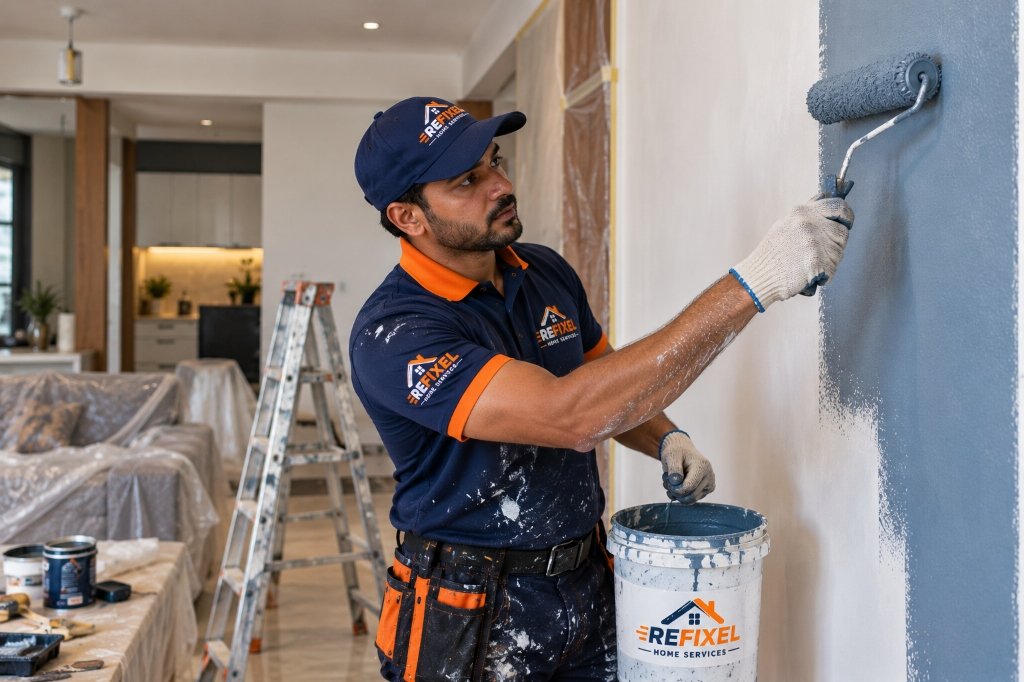
At REFIXEL, we approach wall painting as an engineering science rather than a cosmetic cover-up. Our painting crew follows a strict diagnostic procedure:
Step 1: Digital Moisture Meter Profiling
Before preparing any quote or surface, our supervisor scans affected walls using a calibrated pinless digital moisture meter. Walls registering moisture levels above 15% cannot be painted immediately and require negative-side crystallization treatment.
Step 2: Plaster Excavation & Salt Neutralization
We chisel off all hollow, salt-eaten plaster down to the original red brick masonry (typically up to 3 to 4 feet from floor level). The exposed brickwork is thoroughly wire-brushed and washed with an anti-efflorescence chemical neutralizing wash that arrests salt migration.
Step 3: Two-Component Polymer Waterproof Barrier
We apply a two-coat elastomeric crystalline waterproofing compound (such as Asian Paints SmartCare Damp Block Ultra). The polymer penetrates deep into concrete capillaries, expanding upon contact with moisture into insoluble crystals that block water pathways permanently.
Step 4: Breathable Acrylic Emulsion Topcoat
Once the waterproof barrier cures, we apply water-resistant acrylic putty followed by mechanized dust-free sanding and two coats of breathable anti-fungal luxury emulsion like Royale Shyne or Apex Ultima, providing smooth walls backed by an audited 3-year warranty.