 +91



The Evolution of Residential Interiors in the Terai Region
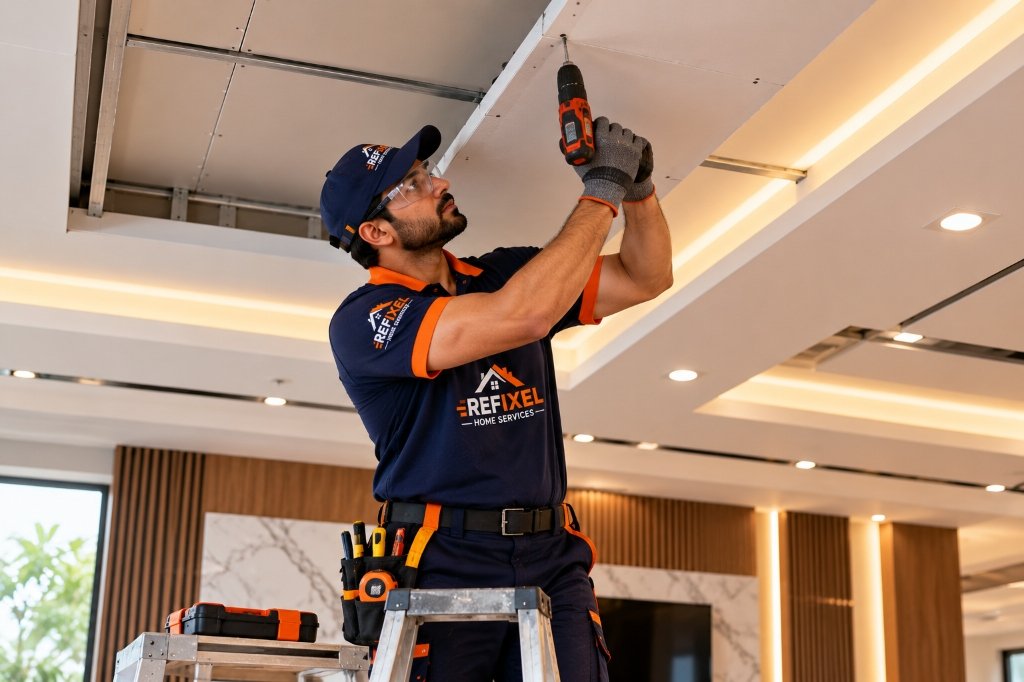
Over the past five years, homeowners across Kashipur, Jaspur, and Thakurdwara have embraced contemporary interior design. Modern false ceilings have become a central architectural feature in drawing rooms, master suites, and dining areas. A well-engineered false ceiling does far more than look luxurious — it conceals split AC copper conduits, allows the installation of indirect 3000K warm ambient cove lighting, improves acoustic damping, and creates a critical thermal insulation barrier beneath hot roof slabs.
However, when planning an interior renovation, homeowners face a common dilemma: "Should we choose traditional Plaster of Paris (POP) or modern Saint-Gobain Gyproc Gypsum plasterboard?"
Technical Comparison: Gypsum Boards vs Traditional POP
To make an informed investment, consider how both materials compare across practical parameters:
1. Structural Uniformity & Finish Quality
Gypsum boards are manufactured in automated factories under strict quality control, ensuring sheets that are 100% flat with identical thickness (12.5mm). Once jointed, the ceiling provides a laser-straight surface. Conversely, traditional POP relies on on-site mixing of powder and water applied manually onto wire chicken mesh by local masons. This process is inherently prone to surface waviness, thickness variations, and visible trowel marks under indirect cove lighting.
2. Installation Speed & Household Cleanliness
Gypsum ceiling installation is a dry construction process. A 1,000 sq. ft. residential apartment can be completely framed, sheeted, and jointed within 4 to 6 days with minimal cleanup. POP, however, involves messy wet slurry that splatters onto walls and floors, requiring 15 to 20 days of wet application and drying time before paint primers can be applied.
3. Crack Resistance & Durability
Due to intense seasonal temperature fluctuations in Uttarakhand — ranging from near-freezing winter nights to 44°C summer afternoons — building roof slabs expand and contract. POP has low tensile flexibility and frequently develops hairline shrinkage cracks along beam corners. Modern Gyproc gypsum systems incorporate flexible fiberglass jointing tape and polymer compounds that absorb micro-movements without cracking.
Why REFIXEL Specializes in Engineered Gyproc Systems
At REFIXEL, our interior installation teams use only certified materials and precision instruments:
- 360° Laser Leveling: We use electronic cross-line laser levels to establish perimeter channel heights with sub-millimeter precision, guaranteeing zero ceiling sag across wide spans.
- Heavy-Gauge GI Framing: We install 0.50mm B.M.T. hot-dipped galvanized iron intermediate and ceiling sections that resist rust even in humid coastal or Terai conditions.
- Seamless Profile & Magnetic Track Integration: Gypsum boards allow precise flush routing for contemporary magnetic track lighting, recessed linear architectural profiles, and linear AC slot diffusers.
Cost Estimates in Kashipur and Jaspur
Standard flat gypsum ceilings with perimeter indirect light coves typically range between ₹95 and ₹125 per square foot (inclusive of GI framework, Saint-Gobain boards, jointing, and labor). Custom multi-level architectural designs with integrated acoustic insulation range from ₹135 to ₹170 per sq. ft.