 +91



Commercial Fire Hazards in Commercial Kitchens
Commercial restaurants and banquet halls along Station Road and Bazpur Road in Kashipur operate tandoors, deep fryers, and high-flame Chinese wok ranges for over 14 hours every day. Cooking oil vapors, carbonized spices, and animal fats are constantly drawn into the commercial exhaust canopy and vertical ductwork. Over months of high-volume cooking, these vapors condense into a flammable, tar-like grease layer coating the interior duct walls.
When grease accumulation exceeds 3mm, it represents an imminent fire hazard. A single flare-up on a wok burner can ignite the canopy filters, sending flames roaring up the vertical exhaust shaft. Furthermore, heavy grease impedes airflow, filling the kitchen with suffocating smoke and triggering health compliance citations.
The Client Dilemma: Zaika Heritage Restaurant
Zaika Heritage Restaurant, a high-volume multi-cuisine eatery near Kashipur Railway Station, faced reduced exhaust suction and an upcoming FSSAI and municipal fire inspection. Their 16-foot stainless steel extraction hood and 35-foot vertical duct had developed an estimated 40mm of hardened grease crust. Crucially, the management could not afford to close the restaurant during lunch or dinner hours, requiring all restoration to occur strictly overnight between 11:30 PM and 5:00 AM.
Overnight Execution by REFIXEL Commercial Hygiene Team
REFIXEL mobilized a specialized 5-member commercial deep cleaning crew equipped with industrial extraction tools and personal protective gear:
1. Kitchen Containment & Appliance Masking
Before beginning mechanical scraping, the entire cooking line — including gas ranges, stainless steel preparation tables, refrigeration units, and dry spice storage racks — was sealed beneath heavy-duty fire-retardant plastic drop cloths to eliminate cross-contamination.
2. Mechanical Grease Scraping
Technicians entered the duct through inspection access ports. Using spark-free non-ferrous brass scrapers, they physically scraped over 35 kg of hardened, carbonized grease crusts directly into collection bags.
3. Superheated 140°C Steam & Alkaline Degreaser Injection
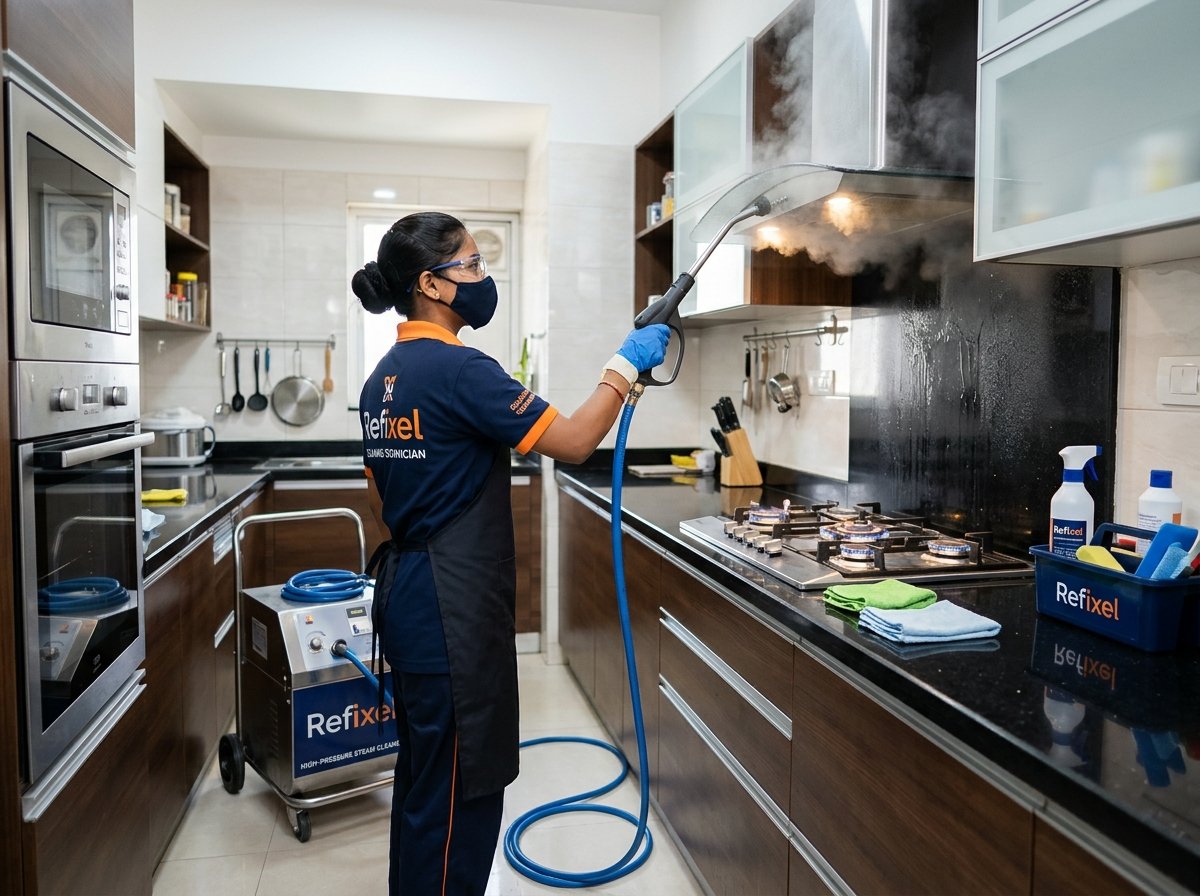
We applied an industrial food-grade alkaline degreasing chemical formulated to saponify stubborn vegetable and animal oils. This was followed by high-pressure injection of superheated 140°C steam, which dissolved the remaining oil film down to bare, gleaming stainless steel.
4. Centrifugal Blower Motor Balancing & Servicing
The roof-mounted centrifugal exhaust fan was disassembled, cleaned of grease ballast on the impeller blades, and re-greased with high-temperature bearings. Airflow resistance dropped immediately, restoring whisper-quiet suction.
Outcome & Official Certification
The entire operation was completed by 4:45 AM, allowing morning baking and prep work to begin on schedule. Exhaust air velocity at the canopy lip surged from a sluggish 240 FPM to 590 FPM. The restaurant passed its safety inspection with flying colors.