 +91



The Recurring "Gas Top-Up" Problem in the Terai Belt
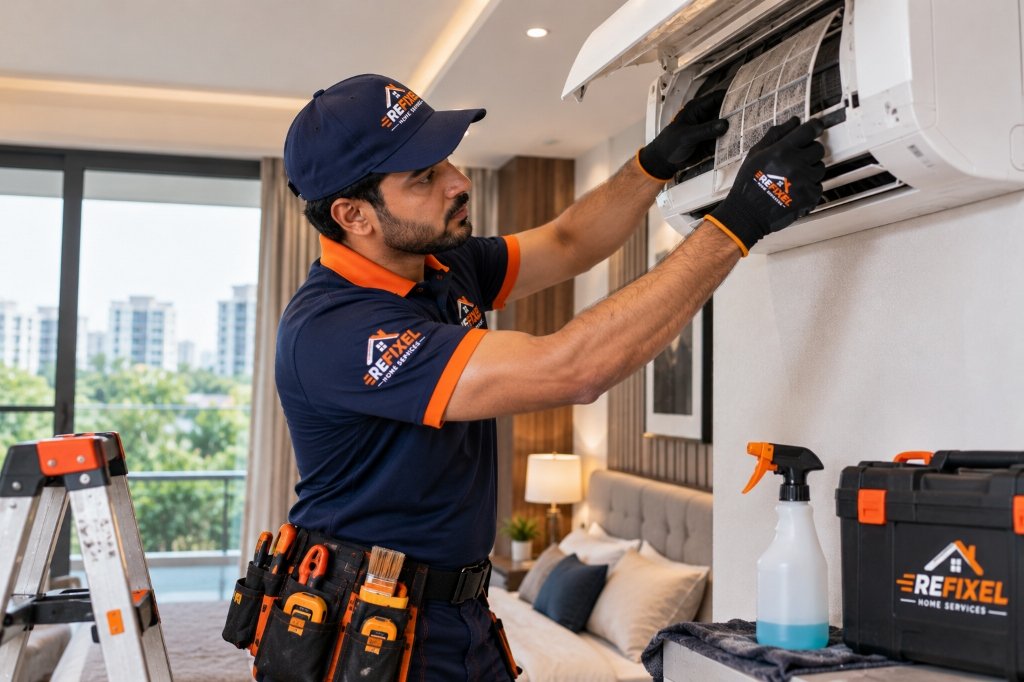
One of the most widespread complaints among air conditioner owners in Jaspur, Kashipur, and Thakurdwara is paying ₹2,500 to ₹3,500 for "AC gas refill" every summer, only to find the unit blowing warm air again within two to three weeks. In air conditioning engineering, refrigerant operates inside a hermetically sealed closed loop — refrigerant is never "consumed" or "burned off" like engine petrol. If an air conditioner is low on gas, there is an active physical leak.
The Client Case: Mr. Gurpreet Singh, Jaspur
In September 2026, Mr. Gurpreet Singh from Kashipur Road in Jaspur reached out to REFIXEL. His 2.0-ton Daikin inverter split AC had stopped cooling. Two separate local technicians had charged R-32 refrigerant into the unit over the preceding 45 days, charging hefty fees each time without testing for leaks. Within 15 days of each refill, the unit tripped on an "F3/L5" compressor high-discharge temperature error.
Why Uncalibrated Air Testing Causes Compressor Destruction
Many untrained local handymen test for leaks by using a domestic refrigerator compressor to pump ordinary ambient air into the AC pipes. This is catastrophic for modern inverter units: ambient air contains high humidity. When pressurized air enters copper tubing, moisture mixes with synthetic Polyolester (POE) compressor oil, forming highly corrosive hydrofluoric acid that dissolves motor winding enamel and leads to permanent compressor burnout.
REFIXEL's Precision 5-Step Engineering Resolution
1. High-Pressure Pure Nitrogen Testing at 350 PSI
REFIXEL never uses ambient air. Our technician connected a commercial cylinder of dry oxygen-free nitrogen (OFN) and pressurized the isolated indoor evaporator circuit up to 350 PSI, holding it under pressure while monitoring with digital test gauges.
2. Pinpointing the Micro-Fissure
Within 15 minutes, the gauge showed a minor pressure drop of 4 PSI. Using an electronic halogen sniffer and high-viscosity bubble solution, our technician located microscopic porosity on the 3rd copper return bend (U-bend) of the indoor cooling coil, caused by acidic environmental moisture.
3. Silver-Copper Alloy Brazing
Using an oxygen-acetylene precision brazing torch and high-grade 5% silver-phosphorus-copper alloy rods with flux, the technician hermetically sealed the micro-porosity, creating a joint stronger than the original copper tube.
4. Deep Two-Stage Vacuuming to 500 Microns
Before introducing virgin refrigerant, our dual-stage rotary vane vacuum pump ran for 35 minutes, pulling the entire system down to 480 microns on a digital vacuum gauge to evacuate every trace of non-condensable atmospheric gas.
5. Weight-Based Digital Scale Refrigerant Charging
Rather than guessing gas quantity based on erratic pressure readings, our technician charged exactly 960 grams of virgin DuPont R-32 refrigerant using a calibrated digital charging scale as specified on the Daikin outdoor rating plate.
Results Delivered
The AC indoor vent temperature dropped to a crisp 14.2°C, and the compressor ran at a smooth 6.8 Amperes. Mr. Singh confirmed zero gas loss and peak performance through the remainder of the season.